The useful question is not simply “What is the biggest mortgage a lender might approve?” A better affordability estimate asks what monthly housing cost fits your income and debt, how much cash you can safely bring to closing, and whether taxes, insurance, HOA dues or mortgage insurance materially change the result.
CalcStreet Editorial maintains this guide. Calculations follow the site methodology, factual U.S. home-finance claims prioritize primary sources such as the CFPB, and example rates are treated as illustrative assumptions rather than lender quotes.
Read CalcStreet editorial standards →Home affordability is usually constrained by two things at once: a monthly-payment limit based on income and debt, and an upfront-cash limit based on the down payment plus closing costs. The smaller of those constraints tends to matter most.
CalcStreet lets you change both housing and total-debt DTI caps instead of treating one ratio as universal.
1. Start with the monthly housing budget—not the listing price
A home price is only useful after it is translated into a monthly cost. For a financed purchase, that cost can include mortgage principal and interest, property tax, homeowners insurance, HOA dues and mortgage insurance when applicable.
That is why two homes with the same price can feel very different in a monthly budget. Different property taxes, insurance costs, HOA dues, down payments or mortgage rates can move the payment by hundreds of dollars.
The starting income figure commonly used in DTI calculations is income before taxes and payroll deductions.
Look beyond principal and interest when estimating what the home costs each month.
2. Use debt-to-income as a guardrail, not a universal rule
The Consumer Financial Protection Bureau defines debt-to-income ratio (DTI) as your monthly debt payments divided by gross monthly income. Lenders use DTI as one way to judge whether a borrower can manage the payments, but the CFPB also notes that different loan products and lenders can use different DTI limits.
For planning, it is useful to separate a housing-only limit from a total-debt limit. CalcStreet compares those two monthly budgets and uses the tighter constraint. This lets you model a conservative case without pretending that a single ratio guarantees approval.
For example, older rules of thumb sometimes reference 28% for housing and 36% for total debt. Those figures can be useful as an illustrative starting point, but they are not universal qualification limits. Your actual underwriting can differ by lender, loan program, credit profile and other factors.
3. Treat down payment and closing cash as separate decisions
A common mistake is to assume that every dollar available for the purchase can become the down payment. Closing requires additional cash, and keeping an emergency cushion can matter after the keys change hands.
The CFPB says closing costs are typically about 2% to 5% of the purchase price, excluding the down payment, while the actual amount depends on the home, lender, loan type and location. Their homebuying guidance also recommends considering money needed for moving, renovations, furnishings, other savings goals and an emergency cushion before deciding the maximum cash available for closing.
In other words, a bigger down payment can reduce the mortgage amount, but draining the entire cash reserve to achieve it may create a different financial problem.
4. Add costs that do not appear in the headline mortgage payment
The principal-and-interest payment is only part of the monthly ownership cost. Property taxes and homeowners insurance may be paid through escrow or separately. HOA assessments and mortgage insurance can also matter, depending on the property and loan.
The CFPB’s Loan Estimate guidance explicitly encourages borrowers to compare the estimated total monthly payment—not only principal and interest—and to pay attention to taxes, insurance, mortgage insurance and other assessments.
These can vary widely between locations and properties even at the same purchase price.
Loan pricing and mortgage-insurance treatment depend on the actual product and borrower profile.
5. Build an affordability range instead of trusting one maximum
A single “maximum home price” looks precise, but the inputs are not fixed. Rates change. Taxes and insurance vary by property. A different HOA can change the payment. Your preferred emergency reserve can change how much cash you are willing to use.
A more useful workflow is to test three scenarios: a comfortable case, a middle case and an upper-bound planning case. Change the DTI assumptions and recurring costs to see which variable actually limits the purchase.
Try a lower DTI cap, a higher insurance estimate, a smaller down payment or a higher rate and watch which constraint becomes limiting.
A simple example: what the inputs tell you
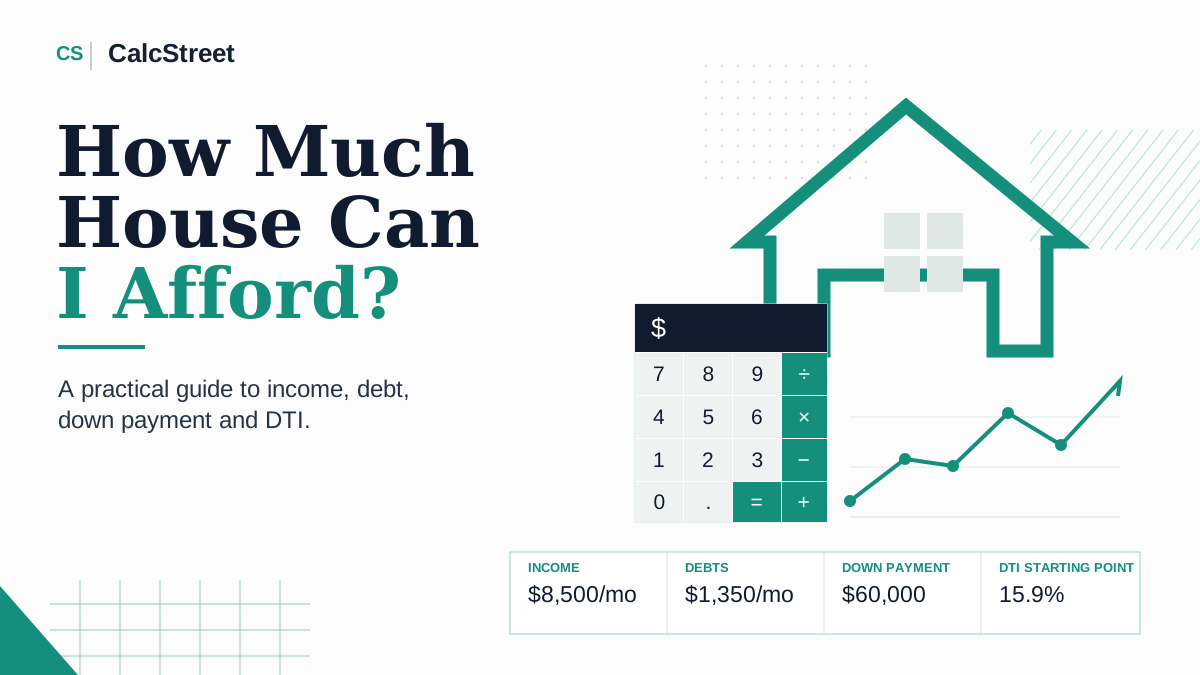
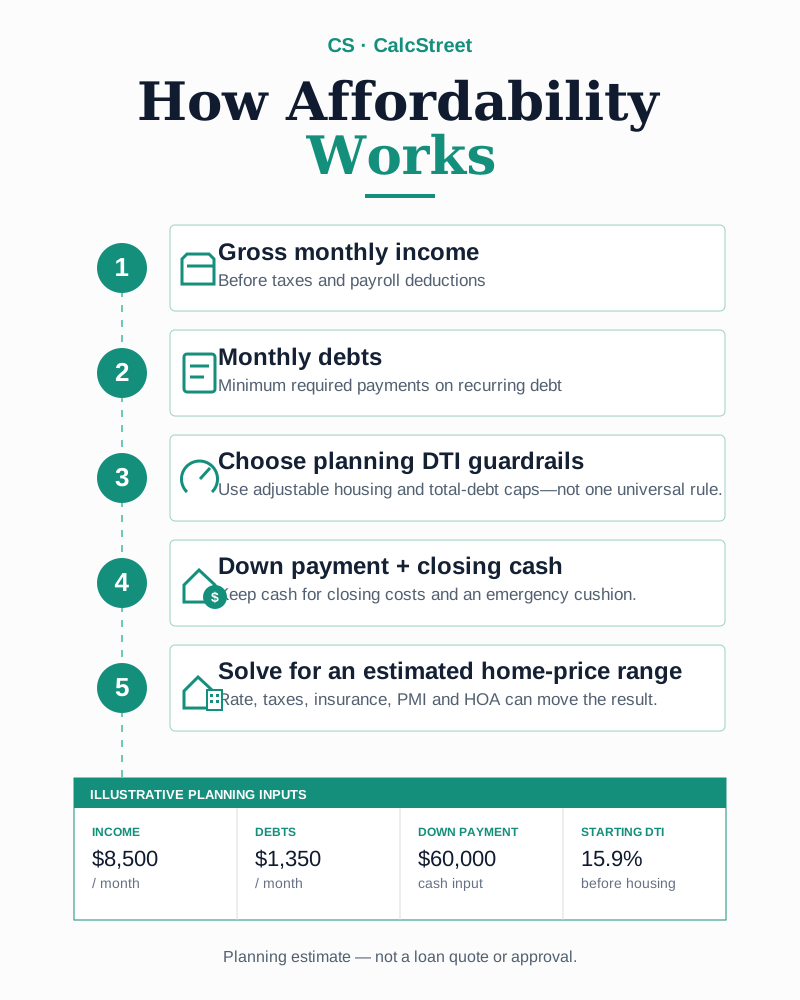
Suppose a household earns $8,500 gross per month, has $1,350 in recurring monthly debt payments and has $60,000 available as a potential down-payment input. Before adding housing, the existing debt payments are about 15.9% of gross monthly income.
That number alone does not tell you the affordable home price. You still need to choose planning DTI caps, estimate the mortgage rate and loan term, and add taxes, insurance, HOA and any mortgage-insurance assumption. You also need to reserve enough cash for closing costs and any cushion you want to keep.
This is why CalcStreet solves backward from the monthly housing budget rather than attaching a generic home-price multiple to income.
Affordability is not the same as approval
An affordability calculator is a planning tool. It cannot evaluate everything a lender uses in underwriting, and it does not know the final property-specific costs until you enter them. A lender may consider credit history, assets, income documentation, loan program rules and other factors that are outside this calculation.
Use the estimate to narrow a shopping range and identify the assumptions that matter. When you are evaluating an actual loan, compare the lender’s Loan Estimate and the full estimated monthly payment with your own budget.