Mortgage discount points can reduce an interest rate, but the value is quote-specific. One point always represents 1% of the loan amount; it does not guarantee a fixed rate reduction. That means the right comparison uses the actual rate and point combinations shown by a lender, not a rule of thumb.
CalcStreet uses standard fixed-rate amortization to compare monthly principal and interest. CFPB guidance is used for the definitions of points, lender credits, APR and loan-offer comparison.
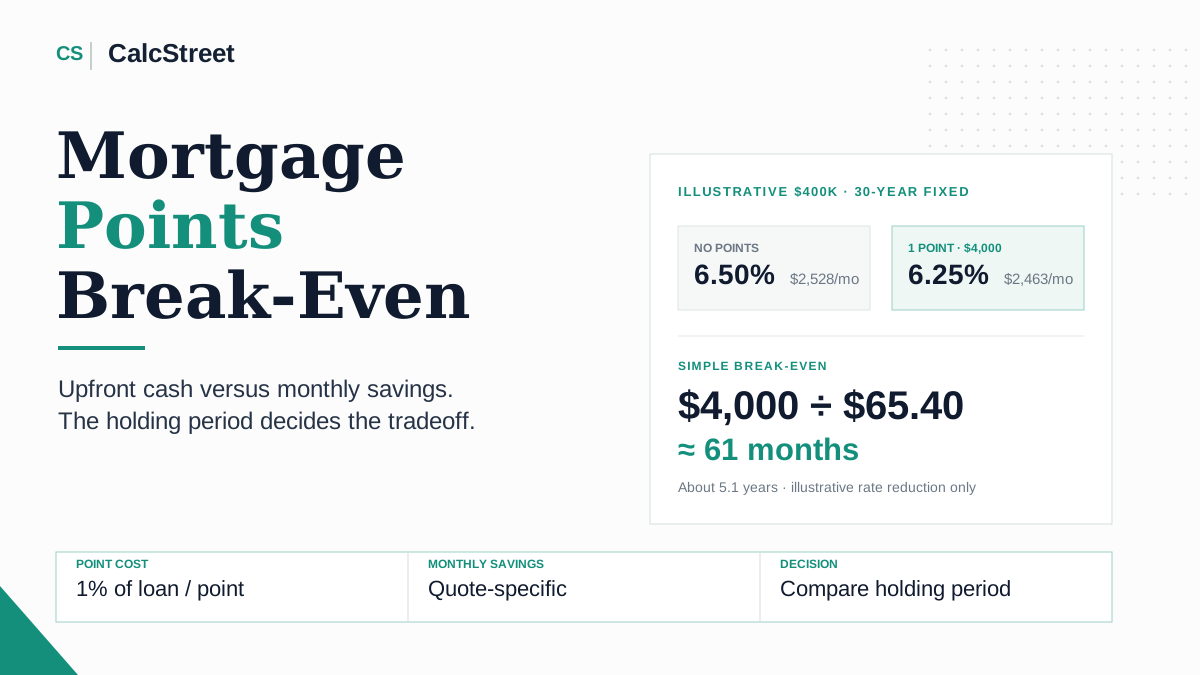
Read CalcStreet editorial standards →A simple mortgage-points break-even period is the upfront cost of the points divided by the monthly payment savings. If points cost $4,000 and reduce principal-and-interest payment by $65.40 per month, the simple break-even is about 61 months, or 5.1 years. If you sell or refinance before then, the monthly savings generally have not recovered the point cost.
What are mortgage discount points?
Discount points are upfront charges paid in exchange for a lower mortgage interest rate. The Consumer Financial Protection Bureau states that one point equals 1% of the loan amount. On a $400,000 mortgage, one point costs $4,000; half a point costs $2,000.
One point does not equal a guaranteed 0.25 percentage-point rate reduction. CFPB guidance says the rate reduction depends on the lender, loan type and market conditions. Use the exact rate-and-point options in the written quote.
How to calculate the mortgage-points break-even period
The simple break-even calculation asks how many months of lower payments are needed to earn back the upfront point cost.
This is a cash-flow shortcut. It does not account for the time value of money, taxes, opportunity cost, other lender fees or a future refinance.
For an apples-to-apples comparison, keep the loan amount and term the same. Calculate principal and interest at the no-point rate, calculate it again at the discounted rate, and subtract the two payments. Then divide the dollar cost of points by that monthly difference.
Worked example: $400,000 mortgage with one point
Assume a 30-year fixed $400,000 mortgage. One hypothetical option has no points at 6.50%. A second hypothetical option costs one point—$4,000—and offers 6.25%. These rates are examples only and are not current market quotes.
$4,000 ÷ $65.40 ≈ 61.2 months, or about 5.1 years. In this illustration, keeping the loan for less than roughly five years leaves the point cost ahead of the accumulated payment savings. Keeping it longer pushes the simple cash-flow comparison in the other direction.
That is about $1,646 less than the $4,000 paid for the point, before considering any other costs or benefits.
That is about $1,494 more than the $4,000 point cost in this simple comparison.
If both loans were kept for all 30 years, the 6.25% example has about $23,545 less scheduled interest than the 6.50% example. That long-run number is not the same as the break-even calculation because many homeowners sell, refinance or otherwise end a mortgage before its scheduled maturity.
When paying points may be more attractive
Points can become more attractive when you have enough cash at closing, the quoted rate reduction is meaningful, and you reasonably expect to keep the mortgage beyond the break-even period. The CFPB specifically recommends comparing total costs over several possible timeframes when you are uncertain how long you will keep the loan.
When paying points may be less attractive
Points can be less attractive when cash at closing is already tight, the quoted rate reduction is small, or there is a meaningful chance you will move, sell or refinance before break-even. Paying points solely because the advertised interest rate looks lower can also hide the true upfront tradeoff.
How to compare mortgage offers with points
The cleanest comparison starts with written Loan Estimates. Compare the same loan type, term and similar lock assumptions. Then check the interest rate, points, lender fees, monthly payment, cash to close and the APR. The CFPB notes that APR is broader than the interest rate because it incorporates points and certain other charges.
Across different lenders, compare offers with the same amount of points or ask each lender for both a zero-point option and a point option. Otherwise a lower advertised rate may simply reflect more money paid upfront.
Mortgage points versus lender credits
Lender credits work in the opposite direction. Instead of paying more upfront for a lower rate, you accept a higher rate in exchange for lender money that offsets some closing costs. That can reduce cash needed at closing while increasing monthly and long-run borrowing cost.
Potentially useful when you expect to keep the loan long enough for savings to recover the upfront cost.
Potentially useful when reducing upfront cash matters more than minimizing scheduled interest.
Use break-even as a decision aid, not a guarantee
The simple break-even formula is intentionally narrow. It does not predict future mortgage rates, whether you will refinance, how long you will own the home, the investment return you could have earned on the upfront cash, or every tax consequence. Use it to make the point tradeoff visible, then compare the complete Loan Estimates and your realistic holding period.
Use CalcStreet to compare principal and interest, then divide the actual point cost by the monthly difference.
For a concrete payment example, see How Much Is the Monthly Payment on a $400,000 Mortgage? or open the $400,000 mortgage calculator.
Sources & further reading
Educational information only, not financial or lending advice. Discount-point pricing and rate reductions vary by lender, loan type and market conditions. Compare complete Loan Estimates and your realistic holding period before deciding whether to pay points.