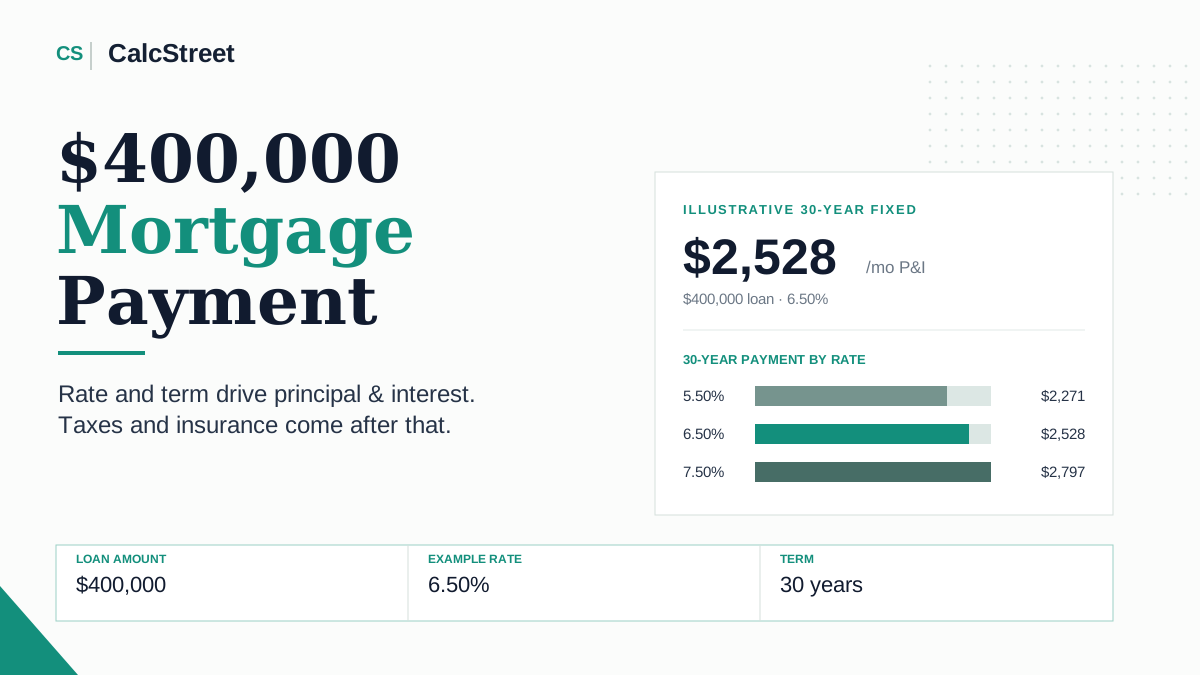
The monthly payment on a $400,000 mortgage is not one fixed number. It depends mainly on the interest rate and loan term, and the amount you actually send toward housing can also include property taxes, homeowners insurance, mortgage insurance and other charges. The cleanest starting point is principal and interest, then add the property-specific costs separately.
CalcStreet uses the standard fixed-rate amortization formula to show how the same $400,000 principal behaves under different rates and terms. Actual lender pricing, fees and eligibility can differ.
Read CalcStreet editorial standards →A $400,000, 30-year fixed mortgage at 6.50% is about $2,528.27 per month in principal and interest. If it were held for all 360 scheduled payments at that rate, modeled lifetime interest would be about $510,178. Taxes, homeowners insurance, mortgage insurance and HOA costs are not included in that headline number.
The $400,000 mortgage calculator lets you replace the illustration with your own assumptions.
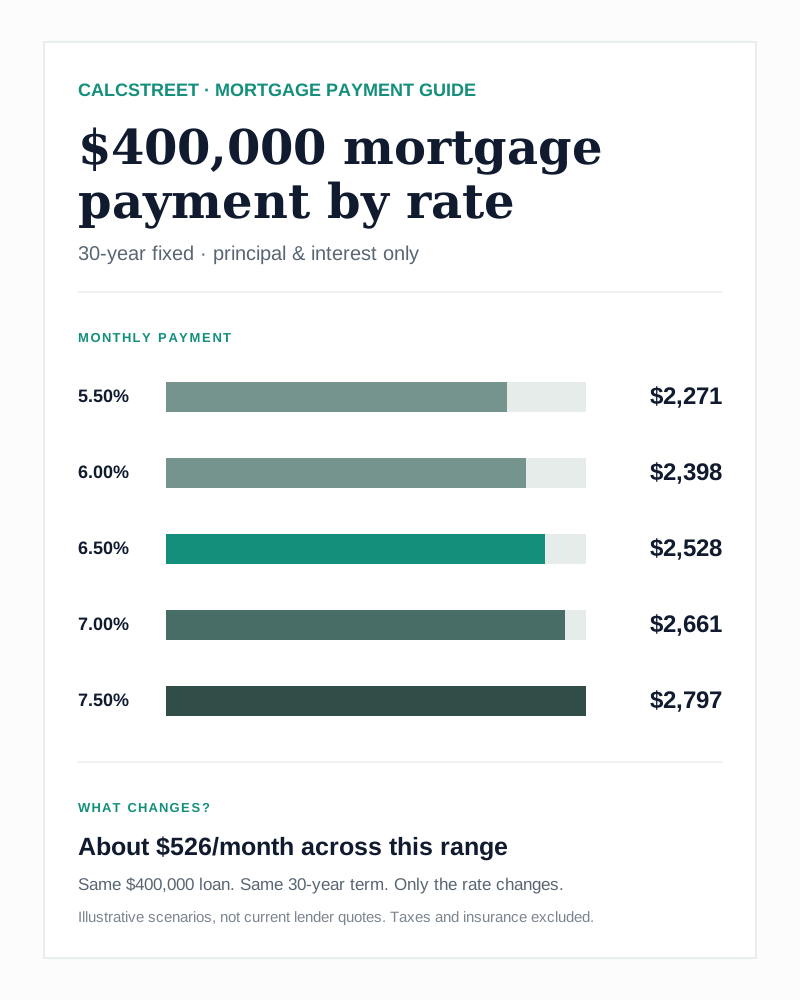
Monthly payment on a $400,000 mortgage by interest rate
Interest rate is one of the largest drivers of payment when the loan amount and term stay the same. The examples below all use a 30-year fixed loan and show principal and interest only.
Across this illustrative 5.50% to 7.50% range, the required principal-and-interest payment changes by about $526 per month. That is why comparing lender offers on the same loan amount and term can matter as much as changing the purchase budget.
How the loan term changes the payment
Keeping the rate at the same illustrative 6.50% makes the term tradeoff easier to see. A shorter term requires more principal to be repaid each month, but it also leaves less time for interest to accumulate.
The 15-year payment is about $956 more each month than the 30-year payment in this same-rate example, while modeled lifetime interest is about $282,981 lower. For a deeper look at that tradeoff, read 15-Year vs. 30-Year Mortgage: Which Costs Less?
A $400,000 mortgage is not the same as a $400,000 home
The mortgage amount is the amount borrowed after the down payment is applied. If the loan itself is $400,000, the home price would be higher whenever you put money down.
These rows simply reverse the down-payment math; they are not recommendations. Loan programs have different minimum down payments, mortgage-insurance rules and eligibility requirements. Closing costs are also separate from the loan amount and down payment unless a specific transaction structures them differently.
Why your actual monthly housing payment can be higher than $2,528
The Consumer Financial Protection Bureau distinguishes principal and interest from the total monthly mortgage payment. A borrower may also pay property taxes, homeowners insurance and mortgage insurance through escrow, while HOA dues are commonly paid separately.
For the headline example: $2,528.27 per month at 6.50% for 30 years.
These can vary substantially by property, location, coverage, loan type and down payment.
For a real mortgage offer, compare the Estimated Total Monthly Payment—not only principal and interest. The CFPB Loan Estimate also shows estimated closing costs and cash to close, making it the better source for a specific lender quote.
What happens to the $400,000 balance over time?
A fixed-rate mortgage is amortizing: the combined principal-and-interest payment stays level, but the mix changes. Early payments contain more interest because the balance is larger; later payments contain more principal.
On the 6.50%, 30-year example, the first payment contains about $2,166.67 of interest and $361.61 of principal. After 5 years of scheduled payments, the modeled balance is about $374,444. After 10 years, it is about $339,105.
How much income do you need for a $400,000 mortgage?
There is no reliable answer from the mortgage amount alone. Lenders evaluate more than the loan payment, and household affordability also depends on other monthly debt, taxes, insurance, down payment, cash reserves and the rest of the budget. If you are working backward from income instead of starting with a loan amount, use the home affordability calculator and read How Much House Can I Afford?
Change the interest rate, term, property tax, insurance, HOA and PMI without changing the $400,000 starting loan amount.
Sources & further reading
- Consumer Financial Protection Bureau — How do mortgage lenders calculate monthly payments?
- Consumer Financial Protection Bureau — Principal and interest vs. total monthly payment
- Consumer Financial Protection Bureau — How does paying down a mortgage work?
- Consumer Financial Protection Bureau — What is a Loan Estimate?