The Consumer Financial Protection Bureau says private mortgage insurance may be required when a borrower takes a conventional mortgage with a down payment below 20%. PMI lowers the lender's risk. It does not insure your ability to make the mortgage payment.
CalcStreet uses CFPB guidance for borrower-paid PMI under the federal Homeowners Protection Act. FHA, VA, USDA, lender-paid mortgage insurance and some other loan structures follow different rules.
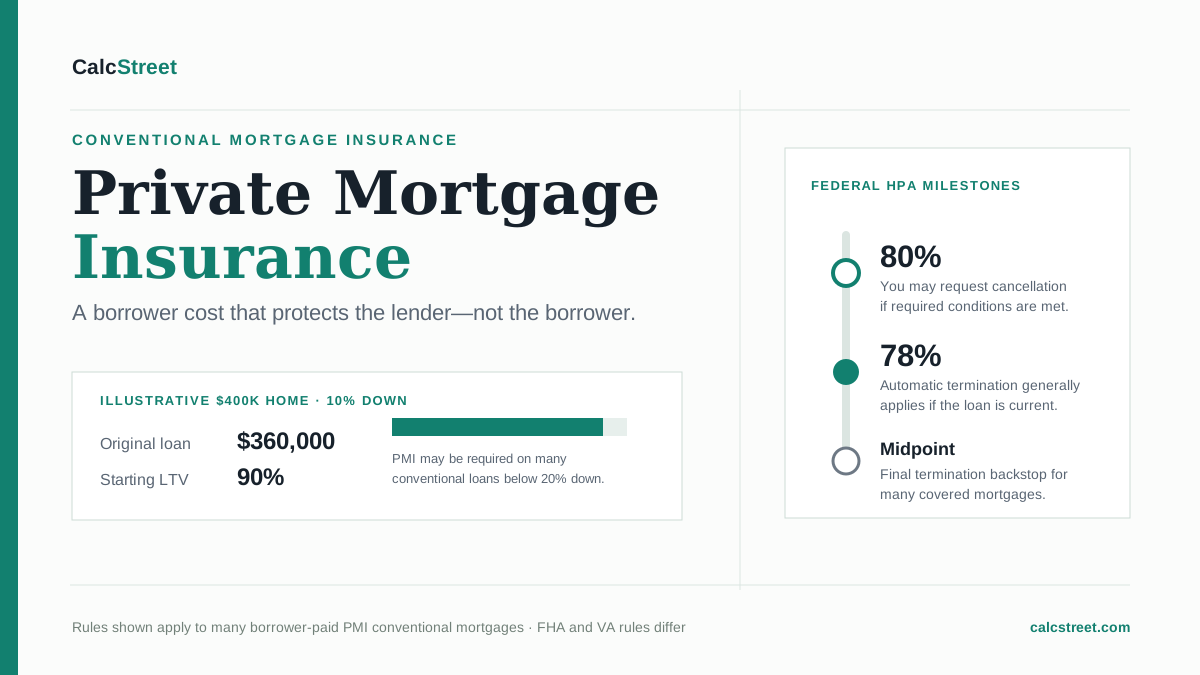
Read CalcStreet editorial standards →PMI is insurance that protects a conventional mortgage lender when the borrower has a relatively small equity cushion. For many covered mortgages, you can request borrower-paid PMI cancellation when the principal balance is scheduled to reach 80% of the home's original value, if required conditions are met. If you are current, automatic termination generally occurs when the balance is scheduled to reach 78% of original value.
What is private mortgage insurance?
PMI is arranged through the lender and provided by a private mortgage insurer. The borrower typically pays the premium, but the protection belongs to the lender. If the borrower defaults and the foreclosure proceeds do not fully cover the mortgage, mortgage insurance can reduce the lender's loss.
PMI does not protect you from foreclosure and does not make your mortgage payments for you. It is a lender-risk product that can allow some borrowers to obtain a conventional mortgage with less than 20% down.
Mortgage insurance on FHA, VA and USDA loans is not the same thing as borrower-paid conventional PMI. Those programs use different premiums, fees and termination rules, so do not apply the 80%/78% milestones below to those loans without checking the program rules.
How is PMI paid?
CFPB notes that the most common arrangement is a monthly PMI premium added to the mortgage payment. Some loans can use an upfront premium, or a combination of upfront and monthly costs. Your Loan Estimate and Closing Disclosure show how the mortgage insurance is structured.
The monthly mortgage-insurance amount appears in the Projected Payments section of the standard loan disclosures.
Some arrangements use a one-time premium. Refund treatment can differ if you later sell or refinance.
A lender may offer more than one structure, which is why the total cost should be compared over a realistic holding period.
A higher interest rate or other pricing can effectively fund the insurance. The borrower-paid cancellation milestones are not directly interchangeable.
The CalcStreet mortgage calculator has a separate PMI input so the cost does not disappear inside the headline payment.
When can borrower-paid PMI be removed?
For many qualifying mortgages on single-family principal residences that closed on or after July 29, 1999, federal law creates three important milestones. The details matter because one is borrower-requested, another is automatic, and a third acts as a final termination backstop.
80%: borrower-requested cancellation
You can generally ask your servicer in writing to cancel PMI on the date the principal balance is scheduled to reach 80% of the home's original value. Extra principal payments can also allow a request once the actual balance reaches 80% of original value.
CFPB lists additional conditions: the request must be in writing; you must have a good payment history and be current; the servicer can require certification that there is no junior lien; and it can require evidence that the property value has not fallen below the original value.
78%: automatic termination
If you do not request cancellation, the servicer generally must terminate borrower-paid PMI on the date the balance is scheduled to reach 78% of the home's original value, provided the loan is current. This is based on the scheduled balance, not simply today's appraised value.
Midpoint: a final termination rule
The federal rules also provide a midpoint backstop. For a 30-year amortization schedule, the midpoint is after 15 years. This can matter for loans where the scheduled balance does not reach the 78% threshold by the midpoint, such as some interest-only, balloon or principal-forbearance structures.
Worked example: $400,000 home with 10% down
Assume a $400,000 home, a $40,000 down payment and a $360,000 conventional mortgage. The starting loan-to-value ratio is 90%.
Using the original $400,000 value, the 80% balance threshold is $320,000 and the 78% balance threshold is $312,000.
At an illustrative 6.50% fixed rate over 30 years with normal scheduled payments, the balance falls below $320,000 around payment 95 and below $312,000 around payment 109. That timing is only a math example: your real cancellation date depends on the actual amortization schedule, extra payments, loan type and servicer requirements.
What can change the PMI rules?
The simple version is useful, but it is not enough for every borrower. Check the loan program, the mortgage investor and whether the insurance is borrower-paid or lender-paid before assuming a cancellation date.
These government-backed programs have their own premium or fee rules and do not use the standard borrower-paid conventional PMI framework.
CFPB notes that investors can create their own cancellation guidelines as long as they are not less favorable than applicable federal protections.
Some investor rules may consider current value, but the federal 80% and 78% framework described here uses original value.
Automatic termination can be delayed when payments are not current, and borrower-requested cancellation has payment-history conditions.
Total monthly payment can include principal, interest, escrow and mortgage insurance.
Sources
Educational information only, not financial, legal or lending advice. PMI rules vary by loan type, investor, insurance structure and payment history. Contact your mortgage servicer for the rules and dates that apply to your loan.