CFPB distinguishes between the principal-and-interest payment and the total monthly payment. The total usually includes additional housing costs such as property taxes and homeowners insurance, often collected through escrow, and it can also include mortgage insurance when applicable.
CalcStreet uses standard fixed-rate amortization for principal and interest. Taxes, insurance, PMI and HOA are treated as explicit assumptions because they cannot be inferred from the loan amount alone.
Read CalcStreet editorial standards →A practical way to think about the total monthly mortgage payment is principal + interest + mortgage insurance, if any, + escrowed property taxes and homeowners insurance. HOA or condo dues, utilities, maintenance and repairs are often separate even though they are still part of the true monthly cost of owning the home.
What can be included in a monthly mortgage payment?
The phrase “mortgage payment” is used loosely. A rate quote might show only principal and interest, while the actual amount paid to the mortgage servicer can include several more components. CFPB warns borrowers not to compare offers using principal and interest alone.
Each scheduled payment reduces the outstanding mortgage balance after the interest due for that month is covered.
For a standard fixed-rate loan, the interest portion starts larger and generally falls as the outstanding balance declines.
Property taxes and homeowners insurance can be collected monthly and paid from an escrow account when the bills come due.
PMI or another mortgage-insurance charge can apply depending on loan type, down payment and insurance structure.
Homeowners association or condo dues are often paid separately. Maintenance, repairs and utilities are also outside the mortgage statement but matter when deciding whether the home fits your budget.
How are principal and interest calculated?
For a fully amortizing fixed-rate mortgage, the scheduled principal-and-interest payment is determined by the loan amount, monthly interest rate and number of monthly payments. The payment stays level, while the split between interest and principal changes over time.
In that formula, P is the starting principal, r is the monthly interest rate and n is the number of monthly payments. For a 30-year loan, n is typically 360. For a 15-year loan, it is typically 180.
Interest each month is calculated from the outstanding balance. Because the balance is highest at the start, more of the fixed payment goes to interest early in the schedule and more goes to principal later.
See 15-Year vs. 30-Year Mortgage for a side-by-side look at how loan term changes the monthly payment and lifetime interest.
Worked example: a $400,000 mortgage
Assume a $400,000 mortgage, 30-year fixed term and an illustrative 6.50% interest rate. The principal-and-interest payment is about $2,528.27 per month.
The tax and insurance numbers are deliberately hypothetical. They show the mechanics of combining the pieces, not an expected cost for a $400,000 loan. Property tax is tied to the property and local tax system; insurance depends on the home, coverage and insurer.
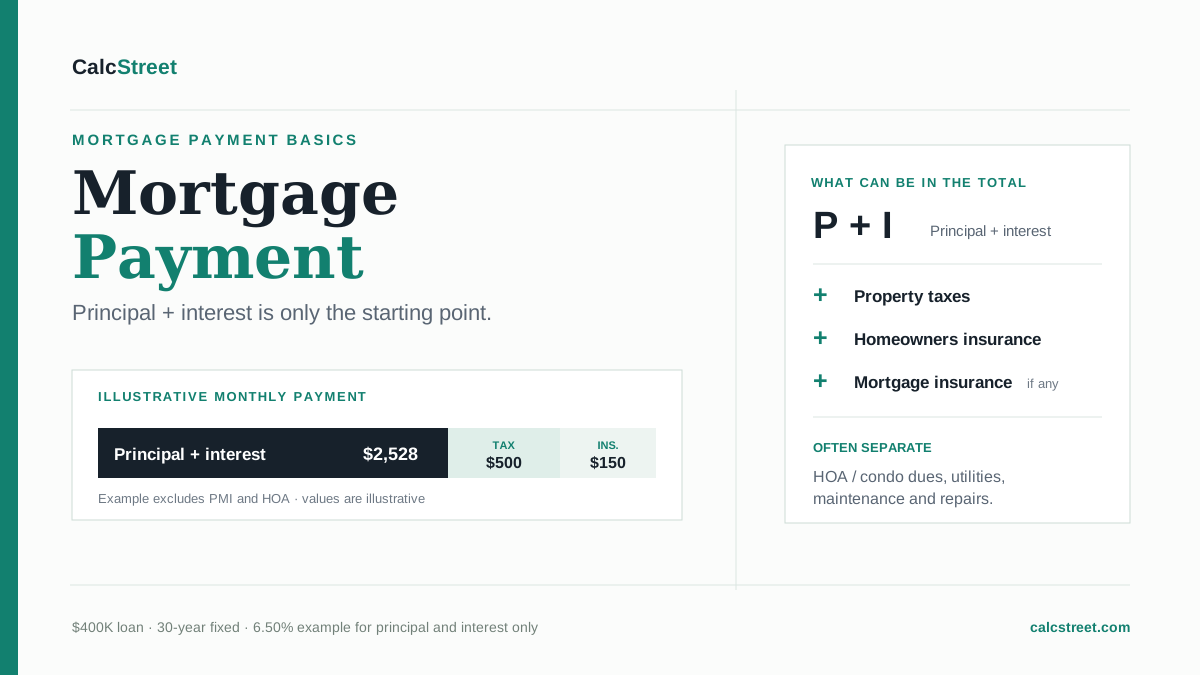
The CalcStreet calculator shows the components and keeps the assumptions visible.
Why a $400,000 mortgage is not a $400,000 home
The loan amount is the amount financed after the down payment and any financed costs. A $400,000 mortgage could be attached to a home worth more than $400,000. Conversely, a $400,000 home with a 20% down payment would have a $320,000 starting loan before other financing adjustments.
For rate-by-rate examples specifically on a $400,000 loan, see How Much Is the Monthly Payment on a $400,000 Mortgage?
Which parts of the payment can change?
Different components follow different rules. On a conventional fully amortizing fixed-rate mortgage, the scheduled principal-and-interest amount is generally stable. The total payment can still change when taxes, insurance or mortgage-insurance charges change.
If taxes and insurance are escrowed, the servicer can adjust the escrow portion after an escrow analysis. See What Is Escrow on a Mortgage? for how that process works.
If you have borrower-paid PMI on a conventional mortgage, the cost can eventually be removable under qualifying circumstances. See What Is PMI and When Can You Remove It?
How should you compare mortgage payments between lenders?
Compare written Loan Estimates for comparable loan scenarios rather than relying on a rate advertisement or a principal-and-interest calculator alone. The standardized form shows the interest rate, projected payments, mortgage insurance when applicable, estimated escrow and closing costs.
A 30-year quote and a 15-year quote are not directly comparable by monthly payment alone.
A lower rate can be paired with more cash upfront; lender credits can reverse that tradeoff.
Mortgage insurance and escrow can materially change the amount actually sent to the servicer.
Down payment, closing costs, prepaids and credits determine how much cash is needed at closing.
For upfront transaction costs, see How Much Are Closing Costs on a House? For rate-buydown tradeoffs, see Mortgage Points: When Does Buying Down the Rate Break Even?
Sources
- Consumer Financial Protection Bureau — Principal and interest vs. total monthly payment
- Consumer Financial Protection Bureau — What costs come with taking out a mortgage?
- Consumer Financial Protection Bureau — What is an escrow or impound account?
- Consumer Financial Protection Bureau — What is private mortgage insurance?
Educational information only, not financial or lending advice. Loan pricing, taxes, insurance, mortgage insurance and association costs vary. Use your Loan Estimate, Closing Disclosure and servicer statements for transaction-specific amounts.