The Consumer Financial Protection Bureau says buyers can use roughly 2%–5% of the home purchase price as an early estimate for closing costs, excluding the down payment. The actual amount can vary materially with the property, loan, lender, services, taxes, insurance, prepaid interest and local rules.
CalcStreet uses CFPB definitions for Loan Estimates, Closing Disclosures, lender credits and cash to close. The worked dollar examples simply apply the CFPB planning range to sample purchase prices.
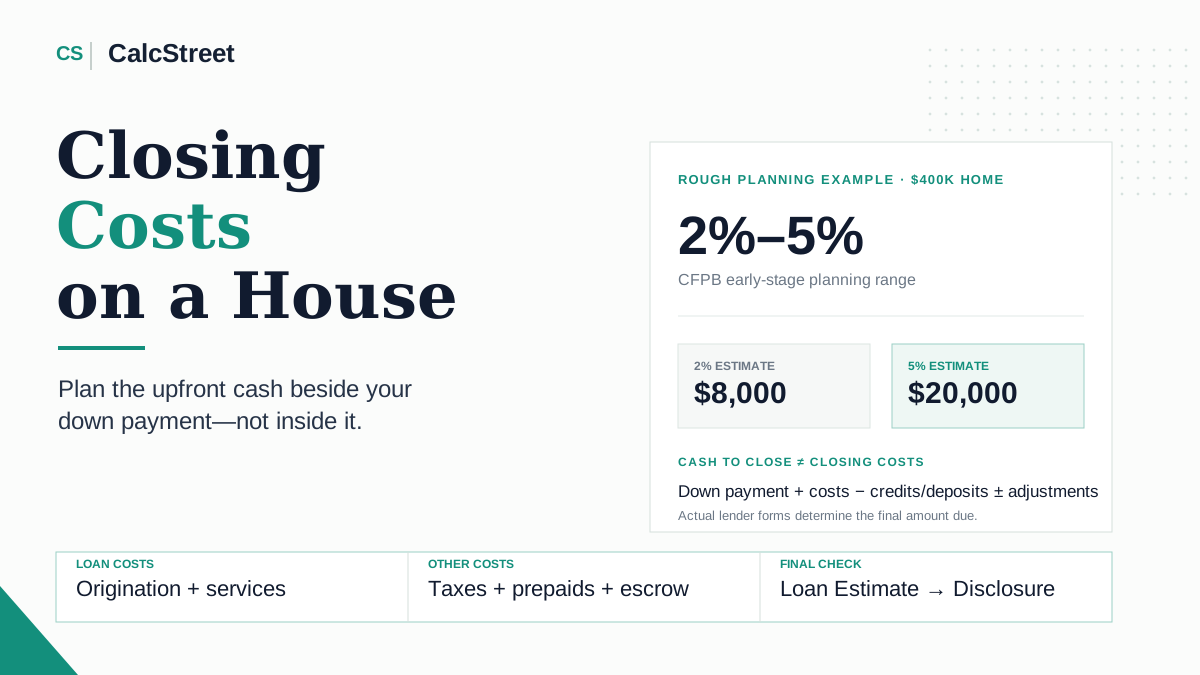
Read CalcStreet editorial standards →A rough early-stage estimate is about 2%–5% of the home purchase price, on top of the down payment. On a $400,000 home, that is roughly $8,000–$20,000. But closing costs are not the same as the final amount you bring to closing. Your cash to close also reflects the down payment, deposits already paid, seller or lender credits and transaction adjustments.
A simple closing-cost estimate: 2%–5%
When you are still deciding how much cash to reserve, a percentage range is useful because exact fees are not available yet. CFPB homebuyer guidance says closing costs, not including the down payment, typically range from 2% to 5% of the home purchase price. Fannie Mae also describes closing costs as commonly around 2%–5% of the mortgage amount, which highlights why the percentage should be treated as a rough planning range rather than a precise rule.
Do not subtract this estimate from the purchase price and call the remainder your down payment. If your cash is limited, reserve for closing costs first, then test the down payment that still leaves enough cash for the transaction and an emergency buffer.
The CalcStreet affordability tool includes a closing-cost assumption so you can see how purchase price, loan size and cash needed at closing interact.
What can be included in closing costs?
Closing costs are not one fee. They are a collection of loan charges, third-party services, government charges, prepaid items and escrow funding. The exact labels appear on the standardized Loan Estimate and later on the Closing Disclosure.
These can include lender origination charges and required services connected with making the mortgage.
Some required services can be shopped for; others are selected or required through the lender process.
Taxes and recording costs vary by location and by how the transaction is structured.
These are cash requirements at closing but are not always best thought of as lender fees.
Loan costs
On the Loan Estimate, loan costs are separated into origination charges, services you cannot shop for and services you can shop for. CFPB guidance recommends paying particular attention to lender-controlled costs when comparing offers, especially origination charges and lender credits.
Taxes and government fees
Recording charges, transfer taxes and similar government-related costs can differ significantly by state and locality. A national percentage estimate cannot predict these accurately for a specific property.
Prepaids and initial escrow
Closing can require prepaid interest for the period between closing and the end of the month, homeowners insurance paid in advance, and money to establish an escrow balance for future taxes and insurance. These amounts depend heavily on timing and location, which is another reason two buyers with the same home price can have different closing totals.
Points and lender credits
Discount points increase upfront cost in exchange for a lower rate. Lender credits move the tradeoff in the opposite direction by offsetting some upfront costs, usually in exchange for a higher rate. If a quote includes either, compare the entire rate-and-cost package rather than the closing-cost total alone.
For the point tradeoff specifically, see Mortgage Points: When Does Buying Down the Rate Break Even?
Closing costs are not the same as cash to close
This distinction is easy to miss. CFPB defines total closing costs as the upfront costs associated with the loan and real estate transaction, excluding the down payment. Cash to close is the estimated amount you still need to bring to closing after combining the down payment, closing costs, deposits already paid, seller credits and other adjustments.
The actual Loan Estimate and Closing Disclosure perform the full transaction-specific calculation. This simplified expression is only for understanding the moving parts.
Worked example: $400,000 home with 20% down
Assume a $400,000 purchase price and a 20% down payment. The down payment is $80,000 and the mortgage is $320,000. Applying the CFPB 2%–5% purchase-price planning range produces an early closing-cost estimate of about $8,000–$20,000.
$80,000 down payment + $8,000–$20,000 closing-cost estimate = roughly $88,000–$100,000 of gross closing cash before deposits, credits and final adjustments.
Suppose the buyer had already paid a $10,000 earnest-money deposit and the contract included a $5,000 seller credit. In a deliberately simplified illustration, those two items could reduce the remaining amount due by $15,000, producing roughly $73,000–$85,000 before other transaction adjustments. The actual lender forms—not this shortcut—determine the number to bring to closing.
Why two $400,000 purchases can have different closing costs
Purchase price is only one variable. A buyer choosing discount points will have different upfront loan costs from a buyer choosing lender credits. A property in a jurisdiction with different transfer or recording charges can produce another total. Closing on a different day of the month changes prepaid interest, and insurance or escrow requirements can change the amount collected in advance.
FHA, VA, USDA and conventional loans can surface different upfront mortgage-insurance or funding-fee items.
State and local rules can materially change costs that a national average cannot capture.
The closing date affects how much interest is collected for the partial month before the first scheduled payment cycle.
Credits can reduce upfront cash but may come with tradeoffs elsewhere in the deal or loan pricing.
How to compare closing costs between lenders
Use written Loan Estimates for comparable loan scenarios. The CFPB requires a lender to provide a Loan Estimate within three business days after receiving a mortgage application. Because lenders use the same standard form, it is easier to compare rate, monthly payment, loan costs, lender credits and estimated cash to close side by side.
Near closing, compare the final Closing Disclosure with the most recent Loan Estimate. CFPB guidance says borrowers generally receive the Closing Disclosure at least three business days before closing, giving time to review final loan terms and costs and ask about material changes.
Can closing costs be reduced?
Some costs are more negotiable than others. You can compare lenders, shop for eligible third-party services, negotiate seller credits where appropriate, and ask lenders to show how lender credits change the interest rate. Each option has tradeoffs, so “lower closing costs” should not be evaluated in isolation from purchase price, loan amount, mortgage rate and long-run borrowing cost.
Costs that are outside the closing-cost estimate
Do not let the 2%–5% range consume every dollar of your homebuying reserve. Moving expenses, repairs, furniture, utility setup, immediate maintenance and an emergency fund are not captured by a mortgage closing-cost percentage. CFPB guidance specifically suggests setting aside money for initial home expenses rather than committing every available dollar to the transaction.
Use the mortgage calculator for monthly payment math, then use affordability to test the down payment and closing-cash assumption together.
For a broader purchase-budget walkthrough, read How Much House Can I Afford? If you are testing a specific loan size, the $400,000 mortgage calculator shows payment and cash-needed assumptions side by side.
Sources & further reading
- Consumer Financial Protection Bureau — Determine your down payment and estimate closing costs
- Consumer Financial Protection Bureau — Loan Estimate explainer
- Consumer Financial Protection Bureau — Closing Disclosure explainer
- Consumer Financial Protection Bureau — Common mortgage closing fees
- Fannie Mae — Closing Costs Calculator
This guide is for educational planning only and is not a loan quote, approval, legal advice or financial advice. Actual fees, credits, taxes, insurance, escrow requirements and cash-to-close calculations depend on your transaction and lender documents.