The Consumer Financial Protection Bureau describes an escrow account—also called an impound account in some places—as an account your mortgage lender or servicer uses to pay certain property-related expenses. A portion of your monthly payment goes into the account so a large tax or insurance bill does not arrive all at once.
CalcStreet follows CFPB definitions for escrow, mortgage servicing and total monthly payment. Dollar examples below are hypothetical and are not estimates for a specific property.
Read CalcStreet editorial standards →Mortgage escrow is money collected with your mortgage payment and held by the servicer to pay bills such as property taxes and homeowners insurance. Escrow does not replace those expenses—it changes when and how you fund them. Because taxes and insurance can change, the escrow part of your monthly payment can change even when your principal-and-interest payment on a fixed-rate mortgage stays the same.
What does a mortgage escrow account pay?
The most common escrow items are property taxes and homeowners insurance. Depending on the property and loan, other insurance-related charges can also be escrowed. The exact list appears in your mortgage disclosures and escrow statements.
Your servicer can collect a portion each month and send the tax payment to the relevant authority on the required schedule.
The servicer holds the monthly set-aside and pays the insurer when the premium is due.
Flood insurance or other required property insurance can be part of the escrow setup depending on the loan and property.
CFPB notes that homeowners association fees are often not included, so check your Closing Disclosure rather than assuming.
Escrow should not be confused with the closing costs paid to originate and settle the transaction. Some money may be deposited into escrow at closing, but the account is designed to fund future property-related bills.
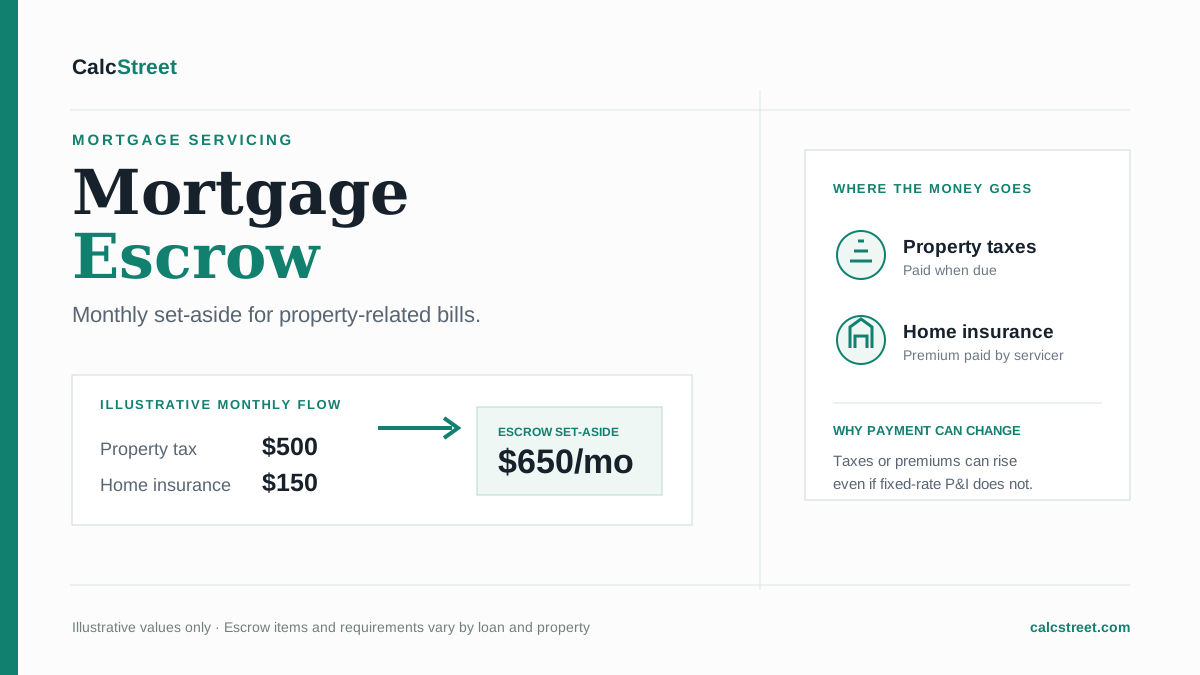
Worked example: $650 a month into escrow
Assume a home has $6,000 of property tax per year and a $1,800 annual homeowners insurance premium. Ignoring timing adjustments and any required cushion, those two bills total $7,800 a year.
If the same borrower had a $400,000, 30-year fixed mortgage at an illustrative 6.50% rate, the principal-and-interest payment would be about $2,528.27 per month. Adding the hypothetical $650 escrow set-aside would produce about $3,178.27 before any mortgage insurance, HOA dues or other housing costs.
The CalcStreet mortgage calculator keeps the components visible rather than hiding them inside one number.
Why can an escrow payment go up or down?
A fixed mortgage rate does not freeze property taxes or insurance premiums. CFPB explains that when those expenses change, the amount needed in escrow—and therefore the total payment you send to the servicer—can change too.
Annual escrow analysis
Servicers periodically analyze the account to compare projected bills with the amount being collected. The analysis can identify a shortage, surplus or deficiency and recalculate the monthly escrow requirement for the next period.
A shortage can occur when taxes or insurance are higher than projected. How it is collected depends on servicing rules and the size of the shortage.
Federal servicing rules govern how qualifying surplus balances are handled and disclosed.
For federally related mortgage loans covered by RESPA escrow rules, there are limits on how much a servicer can require. The regulation also generally caps an escrow cushion at no more than one-sixth of estimated annual escrow payments—roughly two months of the annual disbursements. This is a regulatory ceiling, not a promise that every account will use the maximum cushion.
Why do you sometimes fund escrow at closing?
Your Closing Disclosure can show an initial escrow payment at closing. That money helps establish enough balance for bills that may come due before twelve full monthly deposits have accumulated. The exact amount depends on the closing date, tax schedule, insurance timing and the servicer's escrow calculation.
This is one reason cash to close can include more than the down payment and lender fees. See How Much Are Closing Costs on a House? for the larger cash-at-closing picture.
Can you get a mortgage without an escrow account?
Not every mortgage requires escrow, but many lenders require it and some loan circumstances are subject to legal escrow requirements. If an escrow account is not required, a lender may allow a waiver and in some cases may charge a fee for that choice.
Without escrow, you still owe the property taxes and insurance. The difference is that you must budget and pay the bills yourself, often in much larger installments than a monthly escrow set-aside.
Where can you see your escrow information?
At closing, review the Projected Payments and escrow sections of the Loan Estimate and Closing Disclosure. After closing, your mortgage statements and annual escrow account statements show the amount being collected and how the servicer expects to use it. If the numbers do not match your tax or insurance bills, contact the servicer promptly.
Principal and interest are only part of the monthly housing number.
Sources
Educational information only, not financial, legal, tax or lending advice. Mortgage and escrow requirements vary by loan and jurisdiction. Review your lender and servicer disclosures for your actual account.